


Introduction
If you’re learning Portuguese or have come across the expression “Dado à”, you may wonder what it actually means. Unlike many Portuguese words that have a single English equivalent, Dado à changes its meaning depending on the context. That makes it one of those expressions that can confuse beginners but become incredibly useful once you understand how native speakers use it.
This comprehensive guide explains everything you need to know about Dado à in simple English. You’ll learn its meaning, pronunciation, grammar, English translations, real-life examples, common mistakes, and expert tips. Whether you’re a beginner, traveler, student, translator, or language enthusiast, this guide will help you use the expression naturally and confidently.
By the end of this article, you’ll understand not only what Dado à means but also when to use it, when to avoid it, and how native Portuguese speakers use it in everyday conversations.
Featured Snippet Answer
What does “Dado à” mean?
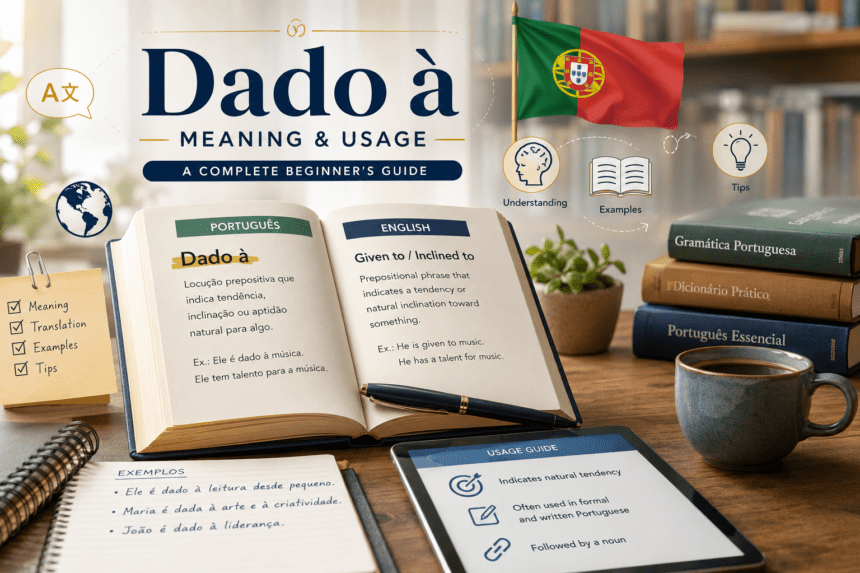
Dado à is a Portuguese expression that generally means “given to,” “inclined to,” “prone to,” “fond of,” or “related to,” depending on the sentence. It describes a person’s tendency, preference, characteristic, or relationship with something. The correct English translation always depends on the context.
Table of Contents
- What Does Dado à Mean?
- Is Dado à a Word or an Expression?
- Literal Translation vs Natural Meaning
- Why Context Matters
- Portuguese Grammar Behind Dado à
- Origin of the Expression
- Historical Background
- Pronunciation Guide
- Word-by-Word Breakdown
- Most Common English Translations
- When to Use Dado à
- When Not to Use It
- Everyday Examples
- Formal Usage
- Informal Usage
- Business Portuguese Examples
- Academic Writing Usage
- Literary Examples
- Common Beginner Mistakes
- Grammar Rules Explained
- Sentence Structure
- Synonyms
- Opposite Expressions
- Similar Portuguese Expressions
- Dado a vs Dado à
- Regional Differences
- How Native Speakers Use It
- Expert Tips
- Practice Exercises
- People Also Ask
- Frequently Asked Questions
- Final Thoughts
What Does Dado à Mean?
At its core, Dado à describes a relationship between a person and a habit, preference, tendency, or characteristic. It usually describes a person’s natural preferences or the activities they are naturally drawn to.
Depending on the context, it can be translated into English as:
- given to
- inclined to
- prone to
- fond of
- accustomed to
- related to
- associated with
Because English uses different phrases for different situations, there isn’t a single translation that fits every sentence.
Example 1
Ele é dado à leitura.
Natural English:
He is fond of reading.
Example 2
Ela é dada à música clássica.
Natural English:
She enjoys classical music.
Example 3
Ele é dado à violência.
Natural English:
He is prone to violence.
Notice how the English translation changes based on the meaning of the sentence rather than following a word-for-word translation.
Is Dado à a Word or an Expression?
Many beginners assume Dado à is a single vocabulary word. In reality, it is a grammatical expression made up of different parts.
- Dado is the past participle of the Portuguese verb dar (“to give”).
- À is the contraction of the preposition a and the feminine definite article a.
Together, they create an expression that conveys a specific meaning beyond the literal translation of its individual words.
Understanding this structure makes it much easier to recognize and use the expression correctly in different situations.
Literal Translation vs Natural Meaning
One of the biggest mistakes language learners make is translating Dado à word for word.
Literal translation:
Given to
While this works in some cases, it often sounds awkward in everyday English.
Instead, native speakers choose translations that sound natural.
| Portuguese | Literal Translation | Natural English |
| Dado à leitura | Given to reading | Fond of reading |
| Dado ao esporte | Given to sports | Interested in sports |
| Dado à discussão | Given to arguments | Prone to arguing |
| Dado à criatividade | Given to creativity | Very creative |
| Dado ao estudo | Given to studying | Dedicated to studying |
Natural translations always communicate the intended meaning rather than translating each word directly.
Why Context Matters
Context is everything when translating Dado à.
Consider these examples:
Example A
João é dado à arte.
Possible translations:
- João loves art.
- João is interested in art.
- João has an artistic nature.
Example B
João é dado à bebida.
Possible translations:
- João drinks a lot.
- João is prone to drinking.
- João has a habit of drinking.
Example C
João é dado à ciência.
Possible translations:
- João enjoys science.
- João is interested in science.
- João has a scientific mindset.
As you can see, choosing the correct English translation depends on understanding the complete sentence, not just the expression itself.
Portuguese Grammar Behind Dado à
To use Dado à correctly, it’s helpful to understand the grammar behind it.
The expression usually appears after a subject and links that subject to a characteristic, habit, preference, or tendency.
A common structure is:
Subject + ser + dado(a) + à + noun
Examples:
- Ela é dada à leitura.
- Pedro é dado à música.
- Maria é dada às artes.
When referring to a masculine noun, the expression changes slightly:
- dado ao esporte
- dado ao trabalho
- dado ao estudo
The article and preposition combine naturally depending on the gender and number of the following noun.
Origin of the Expression
The expression comes from the Portuguese verb dar, meaning “to give.”
Over time, Portuguese speakers began using the past participle dado in descriptive expressions to indicate that someone possesses a natural inclination or tendency toward something.
Today, it is widely accepted in both written and spoken Portuguese and appears in newspapers, literature, academic writing, and everyday conversation.
Historical Background
Historically, expressions built around the verb dar have existed in Portuguese for centuries. Classical Portuguese literature often used dado a or dado à to describe personality traits, habits, and social behaviors.
Modern Portuguese has preserved this usage because it efficiently conveys characteristics without requiring lengthy explanations.
As Portuguese spread across different regions, including Brazil, Portugal, Angola, and Mozambique, the expression remained largely consistent, although frequency and style may vary slightly depending on local speech patterns.
Pronunciation Guide
Correct pronunciation helps you sound more natural.
Approximate pronunciation:
DAH-doo AH
IPA (European and Brazilian pronunciation may differ slightly):
/ˈda.du a/
Remember that the accent in à is not simply decorative. It represents the contraction of the preposition a with the feminine article a, which affects both grammar and pronunciation.
Word-by-Word Breakdown
To truly understand Dado à, it’s helpful to examine each component separately.
Dado
Dado is the past participle of the Portuguese verb dar, which means “to give.”
Examples of the verb dar:
- Dar um presente means to offer someone a gift.
- Dar ajuda — To give help
- Dar atenção — To pay attention
When used in the expression ser dado a/à, the word no longer simply means “given.” Instead, it describes someone’s natural inclination, habit, or preference.
À
The à is a contraction formed by combining:
- a (preposition: “to”)
- a (feminine definite article: “the”)
This contraction is called crase in Portuguese grammar.
For example:
- a + a = à
- a + as = às
Examples:
- à leitura (to reading)
- à música (to music)
- às artes (to the arts)
If the following noun is masculine, you use ao instead:
- ao esporte
- ao trabalho
- ao estudo
Most Common English Translations
Because English doesn’t have one exact equivalent, translators choose different phrases depending on context.
1. Given to
Example:
Ele é dado à filosofia.
Translation:
He is given to philosophy.
This translation is grammatically correct but sounds more formal in English.
2. Fond of
Example:
Ela é dada à leitura.
Translation:
She is fond of reading.
This is one of the most natural translations.
3. Interested in
Example:
Pedro é dado à tecnologia.
Translation:
Pedro is interested in technology.
4. Inclined to
Example:
Ele é dado à reflexão.
Translation:
He is inclined to reflect.
5. Prone to
Example:
Ele é dado à violência.
Translation:
He is prone to violence.
6. Addicted to (Context-Specific)
Example:
Ele é dado à bebida.
Possible translation:
He is addicted to drinking.
This interpretation depends entirely on context, so it should not be used automatically.
When to Use Dado à
You should use Dado à when describing:
Personal Interests
Examples:
- music
- books
- sports
- art
Example:
Ela é dada à música.
Personality Traits
Example:
Ele é dado à paciência.
Meaning:
He is naturally patient.
Habits
Example:
João é dado ao estudo.
Meaning:
João enjoys studying.
Natural Tendencies
Example:
Ela é dada à criatividade.
Meaning:
She naturally thinks creatively.
Lifestyle Characteristics
Example:
Pedro é dado aos negócios.
Meaning:
Pedro has a strong interest in business.
When Not to Use Dado à
Many learners overuse this expression.
Avoid using it when talking about:
Temporary Actions
Incorrect:
Hoje sou dado ao café.
Better:
Hoje quero café.
One-Time Events
Don’t use Dado à to describe something that happened only once.
Incorrect:
Ontem fui dado ao cinema.
Correct:
Ontem fui ao cinema.
Simple Preferences
Sometimes simpler verbs sound much more natural.
Instead of:
Sou dado à pizza.
Use:
Gosto de pizza.
Everyday Examples
Here are examples you may hear in daily conversations.
Example 1
Maria é dada à leitura.
English:
Maria loves reading.
Example 2
Pedro é dado ao esporte.
English:
Pedro enjoys sports.
Example 3
Ela é dada às artes.
English:
She has an artistic personality.
Example 4
João é dado à música.
English:
João loves music.
Example 5
Carlos é dado à aventura.
English:
Carlos enjoys adventure.
Example 6
Ana é dada ao estudo.
English:
Ana is dedicated to studying.
Example 7
Meu avô era dado à jardinagem.
English:
My grandfather loved gardening.
Example 8
Ela sempre foi dada à criatividade.
English:
She has always been creative.
Formal Usage
You’ll often find Dado à in:
- newspapers
- books
- academic writing
- biographies
- historical texts
- official reports
Example:
O pesquisador era dado à investigação científica.
Translation:
The researcher was devoted to scientific research.
Formal writing tends to use this expression because it sounds elegant and descriptive.
Informal Usage
In everyday Brazilian Portuguese, speakers often replace Dado à with simpler expressions.
Instead of:
Ele é dado à música.
Many people simply say:
Ele gosta de música.
Both are correct, but the second is more conversational.
Business Portuguese Examples
Professionals may encounter Dado à in workplace communication or company profiles.
Example:
O candidato é dado à liderança.
Meaning:
The candidate has leadership qualities.
Example:
A equipe é dada à inovação.
Meaning:
The team is inclined toward innovation.
Example:
Nosso gerente é dado ao planejamento.
Meaning:
Our manager values planning.
These expressions are common in corporate reports, performance evaluations, and professional recommendations.
Academic Writing Usage
In academic Portuguese, Dado à frequently appears when describing research interests or scholarly tendencies.
Examples:
O autor era dado aos estudos históricos.
Meaning:
The author was devoted to historical studies.
A pesquisadora era dada à análise crítica.
Meaning:
The researcher specialized in critical analysis.
This usage conveys expertise or long-term dedication rather than a temporary interest.
Literary Usage
Portuguese literature often uses Dado à to add depth to characters.
Example:
O velho era dado às lembranças da juventude.
Natural English:
The old man often reflected on his youth.
Rather than stating a simple fact, the expression paints a richer picture of the character’s personality and habits.
Practical Sentence Patterns
Learning common sentence structures makes it easier to use the expression naturally.
Pattern 1
Subject + ser + dado(a) + à + noun
Example:
Ela é dada à leitura.
Pattern 2
Subject + era + dado(a) + à + noun
Example:
Meu pai era dado à música clássica.
Pattern 3
Subject + foi + dado(a) + à + noun
Example:
O escritor foi dado à poesia durante toda a vida.
Pattern 4
Subject + sempre foi + dado(a) + à + noun
Example:
Ela sempre foi dada às artes.
Quick Practice
Translate these naturally into English:
- Ele é dado à filosofia.
- Ana é dada à pintura.
- João é dado ao esporte.
- Carlos é dado aos estudos.
- Minha irmã é dada à criatividade.
Possible answers:
- He enjoys philosophy.
- Ana loves painting.
- João enjoys sports.
- Carlos is dedicated to studying.
- My sister is naturally creative.
Grammar Rules Explained
Mastering Dado à requires more than knowing its meaning. You also need to understand how Portuguese grammar affects its form. Since the expression agrees with the subject and the noun that follows, small grammar details make a big difference.
Agreement with the Subject
The adjective dado changes according to the gender and number of the subject.
| Subject | Correct Form | Example |
| Masculine Singular | dado | João é dado ao esporte. |
| Feminine Singular | dada | Maria é dada à música. |
| Masculine Plural | dados | Os alunos são dados ao estudo. |
| Feminine Plural | dadas | As meninas são dadas às artes. |
Always make sure dado matches the person or group you’re describing.
Agreement with the Following Noun
The preposition also changes depending on whether the following noun is masculine or feminine.
Feminine Nouns
Use:
- à
- às
Examples:
- à música
- à leitura
- às artes
- às ciências
Masculine Nouns
Use:
- ao
- aos
Examples:
- ao esporte
- ao trabalho
- ao estudo
- aos negócios
Sentence Structure
The most common structure is:
Subject + Verb “Ser” + Dado(a) + Preposition + Noun
Examples:
- João é dado ao esporte.
- Ana é dada à leitura.
- Eles são dados ao trabalho.
- Elas são dadas às artes.
This structure is widely used in both spoken and written Portuguese.
Using Different Verb Tenses
Although the verb ser appears most often in the present tense, the expression works with other tenses too.
Present
Ela é dada à música.
Past
Ela era dada à música.
Present Perfect
Ela tem sido dada aos estudos.
Future
Ela será dada às pesquisas.
Conditional
Ela seria dada às artes se tivesse mais tempo.
Changing the tense changes the time reference but not the core meaning of the expression.
Common Mistakes Beginners Make
Learning from common errors helps you avoid them in your own writing and speech.
Mistake 1: Translating Word for Word
Incorrect approach:
Given to reading
Natural translation:
Fond of reading
Always prioritize natural English over literal translation.
Mistake 2: Forgetting Gender Agreement
Incorrect:
Maria é dado à música.
Correct:
Maria é dada à música.
The adjective must agree with the feminine subject.
Mistake 3: Using the Wrong Article
Incorrect:
João é dado à esporte.
Correct:
João é dado ao esporte.
Since esporte is masculine, ao is required.
Mistake 4: Confusing Temporary Interests with Long-Term Tendencies
Incorrect:
Hoje sou dado ao café.
Correct:
Hoje quero café.
or
Gosto de café.
Dado à describes ongoing characteristics rather than temporary desires.
Mistake 5: Overusing the Expression
Portuguese speakers often choose simpler phrases in everyday conversation.
Instead of:
Sou dado ao futebol.
Many would simply say:
Gosto de futebol.
Understanding when simplicity sounds more natural is an important step toward fluency.
Synonyms
Several Portuguese expressions convey similar meanings depending on the context.
Inclinado a
Meaning:
Inclined toward.
Example:
Ele é inclinado à pesquisa.
Propenso a
Meaning:
Prone to.
Example:
Ele é propenso a acidentes.
Gosta de
Meaning:
Likes.
Example:
Ela gosta de música.
This is much more common in everyday conversation.
Tem Interesse em
Meaning:
Interested in.
Example:
Pedro tem interesse em tecnologia.
Aprecia
Meaning:
Appreciates.
Example:
Ela aprecia literatura clássica.
Dedica-se a
Meaning:
Devotes oneself to.
Example:
Ela dedica-se aos estudos.
Opposite Expressions
Knowing opposites improves vocabulary and helps you express contrasts naturally.
Some common alternatives include:
- Desinteressado em (Not interested in)
- Indiferente a (Indifferent to)
- Avesso a (Opposed to)
- Sem interesse em (Without interest in)
- Não gosta de (Doesn’t like)
Example:
Instead of:
João é dado à música.
You could say:
João é desinteressado em música.
The meaning changes completely.
Dado a vs Dado à
This is one of the most confusing topics for beginners.
Although they look similar, they are not always interchangeable.
Dado à
Used when the following noun is feminine.
Examples:
- à leitura
- à música
- à arte
- à criatividade
Dado ao
Used with masculine nouns.
Examples:
- ao esporte
- ao estudo
- ao trabalho
- ao comércio
Dado a (Without Accent)
Sometimes a is only a preposition rather than a contraction.
Example:
Dado a entender…
Here the grammar is different, and no crase is used.
The accent depends entirely on the noun and sentence structure, so it’s important not to add à automatically.
Regional Differences
One advantage of learning Dado à is that it is understood across the Portuguese-speaking world.
However, usage frequency varies slightly.
Brazil
In Brazil, people often replace the expression with simpler alternatives like:
- gosta de
- curte (informal)
- aprecia
- tem interesse em
You’ll still see Dado à in:
- newspapers
- books
- biographies
- academic texts
- legal documents
Portugal
European Portuguese tends to preserve traditional expressions more often.
Because of this, Dado à appears frequently in:
- literature
- newspapers
- essays
- historical writing
- formal conversations
Other Portuguese-Speaking Countries
In countries such as Angola, Mozambique, Cape Verde, and Guinea-Bissau, the expression is generally understood and used in formal writing, although everyday speech may favor simpler alternatives depending on regional habits.
How Native Portuguese Speakers Use Dado à
One of the best ways to sound natural is to observe how native speakers use the expression.
Rather than forcing Dado à into every sentence, they typically reserve it for describing someone’s long-term personality, behavior, or interests.
For example, instead of saying:
João gosta de arte.
A writer or speaker might say:
João é dado às artes.
The second version sounds more descriptive and refined. It suggests that João has an artistic disposition rather than simply enjoying art occasionally.
This subtle difference is why the expression is especially common in biographies, profiles, literature, and formal writing.
Expert Tips for Using Dado à Naturally
Focus on Long-Term Characteristics
Use the expression to describe habits, personality traits, or enduring interests rather than temporary actions.
Match Gender and Number Carefully
Double-check both the adjective (dado/dada/dados/dadas) and the article (ao/à/aos/às) to ensure grammatical agreement.
Choose the Most Natural English Translation
Avoid translating Dado à word for word. Ask yourself what sounds natural in English:
- fond of
- interested in
- inclined to
- prone to
- devoted to
Read Authentic Portuguese Content
Books, newspapers, and magazines are excellent places to see the expression used correctly in context.
Practice with Real Sentences
Create your own examples based on hobbies, professions, or personality traits. Regular practice will help you remember the correct structure and use it more confidently.
Practice Exercises
The most effective way to learn and remember ‘Dado à’ is by practicing it within real-life sentences. Try these short exercises before checking the answers.
Exercise 1: Choose the Correct Form
1. Maria é ______ música.
A. dado ao
B. dada à
C. dado à
Answer: B. dada à
2. João é ______ esporte.
A. dado ao
B. dada ao
C. dado à
Answer: A. dado ao
3. As meninas são ______ artes.
A. dados às
B. dadas às
C. dada às
Answer: B. dadas às
4. Pedro é ______ leitura.
A. dado à
B. dado ao
C. dada à
Answer: A. dado à
Exercise 2: Translate into English
Translate these naturally rather than word for word.
1.
Ela é dada à música.
Suggested Answer:
She is fond of music.
2.
João é dado ao esporte.
Suggested Answer:
João enjoys sports.
3.
Carlos é dado aos estudos.
Suggested Answer:
Carlos is dedicated to studying.
4.
Maria é dada às artes.
Suggested Answer:
Maria has an artistic nature.
5.
Meu avô era dado à jardinagem.
Suggested Answer:
My grandfather loved gardening.
Exercise 3: Fill in the Blank
Complete the sentence with the correct form.
- Ana é ______ leitura.
- João é ______ trabalho.
- Os alunos são ______ pesquisa.
- As professoras são ______ inovação.
Answers
- dada à
- dado ao
- dados à pesquisa
- dadas à inovação
Real-Life Conversation Examples
Here are a few natural dialogues that show how the expression is used.
Example 1
Person A: Como é o Paulo?
Person B: Ele é dado ao esporte e à natureza.
English
A: What’s Paulo like?
B: He’s interested in sports and nature.
Example 2
Person A: Sua irmã gosta de ler?
Person B: Sim, ela é dada à leitura desde criança.
English
A: Does your sister like reading?
B: Yes, she’s loved reading since childhood.
Example 3
Person A: Como era seu avô?
Person B: Ele era dado à jardinagem e à pesca.
English
A: What was your grandfather like?
B: He loved gardening and fishing.
Quick Revision
Before moving on, remember these key points:
- Dado à is an expression, not a standalone word.
- Its meaning changes with the context.
- Common English translations include fond of, inclined to, prone to, interested in, and devoted to.
- The adjective must agree with the subject.
- The article must agree with the following noun.
- The expression usually describes long-term interests, habits, or personality traits.
- In everyday speech, simpler alternatives like gostar de are often more common.
People Also Ask
What does Dado à mean in English?
Depending on the context, it can mean given to, fond of, interested in, inclined to, prone to, or devoted to.
Is Dado à formal or informal?
It appears in both forms of Portuguese, but it is more common in formal writing, literature, biographies, academic texts, and professional communication than in casual conversation.
Is Dado à used in Brazil?
Yes. Brazilian Portuguese speakers understand and use it, although everyday speech often favors simpler alternatives such as gostar de.
Is Dado à used in Portugal?
Yes. It is widely used in European Portuguese and appears frequently in newspapers, books, essays, and formal discussions.
Can beginners use Dado à?
Absolutely. Once you understand gender agreement, article usage, and context, it becomes a valuable expression for sounding more natural and descriptive.
Does Dado à always mean “given to”?
No. “Given to” is the literal translation, but natural English often uses fond of, interested in, prone to, or devoted to, depending on the sentence.
Frequently Asked Questions (FAQ Schema Style)
1. What is the meaning of Dado à?
It describes someone’s tendency, preference, or natural inclination toward something.
2. Is Dado à an adjective?
It functions as part of an adjectival expression built from the past participle of the verb dar.
3. What is the difference between Dado à and gostar de?
Gostar de simply means “to like,” while Dado à often suggests a stronger, more enduring characteristic or inclination.
4. Can Dado à describe personality?
Yes. It is commonly used to describe habits, behaviors, interests, and personality traits.
5. Is Dado à common in everyday speech?
It is understood everywhere, but casual conversations often use simpler expressions.
6. Can it describe negative tendencies?
Yes. For example:
Ele é dado à violência.
This means he is prone to violence.
7. Does the expression change for women?
Yes. Use dada for feminine subjects.
Example:
Ela é dada à música.
8. Can it be used in business writing?
Yes. It frequently appears in company profiles, evaluations, recommendation letters, and leadership descriptions.
9. Is Dado à difficult to learn?
Not once you understand agreement rules and practice with authentic examples.
10. What’s the easiest way to remember it?
Think of it as describing a person’s long-term interest or natural tendency rather than a temporary action.
11. Is Dado à still used today?
Yes. It remains a standard and widely recognized expression across Portuguese-speaking communities.
12. How can I master its usage?
Read Portuguese articles, books, and biographies, listen to native speakers, and create your own practice sentences.
Final Verdict
Dado à is one of those Portuguese expressions that becomes much easier once you stop translating it literally. Instead of thinking only about the words themselves, focus on the idea they express—a person’s natural tendency, enduring interest, or characteristic.
Whether you’re reading literature, translating documents, preparing for a language exam, or simply expanding your vocabulary, understanding this expression will make your Portuguese feel more accurate and natural.
Remember that context always determines the best English translation. Sometimes fond of is perfect; in other cases, inclined to, prone to, interested in, or devoted to conveys the intended meaning more effectively.
The more authentic Portuguese you read and hear, the more familiar this expression will become. With regular practice and attention to grammar, you’ll soon recognize Dado à instantly and use it confidently in both speaking and writing.
Conclusion
Learning Portuguese isn’t just about memorizing vocabulary—it’s about understanding how native speakers express ideas naturally. Dado à is an excellent example of an expression whose meaning depends on context, grammar, and usage rather than a simple word-for-word translation.
By learning its structure, agreement rules, common meanings, and real-life usage, you’ve made a key move toward improving your Portuguese fluency. Keep practicing with authentic materials, pay attention to context, and don’t be afraid to use the expression in your own sentences.
Over time, Dado à will become a natural part of your Portuguese vocabulary, helping you communicate with greater confidence and accuracy.