


Featured Snippet
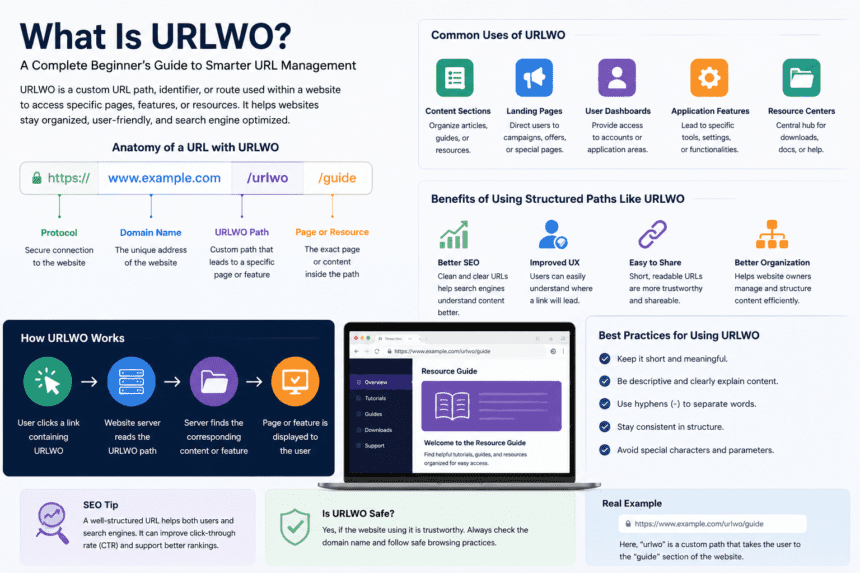
URLWO is a term commonly associated with a custom URL path, web identifier, or platform-specific URL structure used to organize and access content online. Although URLWO does not have a universal definition, it is often used as a unique page route, resource identifier, or website navigation element that helps users and search engines locate specific content efficiently.
What Is URLWO?
URLWO is a term that appears within certain web addresses, page paths, or online platforms. Unlike commonly recognized internet terms such as URL, domain, or hyperlink, URLWO does not have a standardized technical definition accepted across the web. Instead, its meaning depends largely on the website or platform where it is used.
In many situations, URLWO functions as a custom identifier within a website’s URL structure. Website developers often create unique path names, directories, and route identifiers to organize content, services, user profiles, or application features. URLWO may represent one of these custom routes that direct users to a specific section of a website.
For beginners, it is important to understand that URLWO should not automatically be considered a software tool, programming language, or internet protocol. Rather, it is generally viewed as a website-specific naming convention that helps structure digital content and navigation.
Understanding the Meaning of URLWO
The meaning of URLWO can vary depending on context. Since there is no official dictionary definition or universally accepted technical standard for the term, understanding it requires examining where it appears and how it functions within a website.
Why URLWO Does Not Have a Universal Definition
Unlike terms such as HTML, CSS, or URL, URLWO is not part of established internet terminology. It appears to be a custom-created label, route name, or identifier chosen by a website owner, developer, or platform administrator.
Modern websites often create unique naming systems for directories, product categories, user pages, and application routes. Because these names are custom-built, they do not necessarily carry the same meaning across different websites.
For example, one website might use URLWO as a content directory, while another platform could use the same term for an internal application route. This flexibility explains why users searching for URLWO often encounter different interpretations online.
Another reason for the confusion is that internet users naturally expect unfamiliar terms to have fixed definitions. In reality, many URL elements are created solely for organizational purposes and only make sense within their original environment.
Breaking Down the Term URLWO
The first part of the term, “URL,” commonly refers to a Uniform Resource Locator, which is the address used to locate resources on the internet. Every webpage, image, video, or online document is accessed through a URL.
The second portion, “WO,” does not have an established internet-related meaning. It may represent an abbreviation, internal code, branding element, project name, or organizational identifier selected by a website owner.
When combined, URLWO may simply serve as a custom page path or route identifier rather than a standalone technology. This interpretation aligns with how many modern websites structure their web addresses.
Because website administrators have complete freedom when naming directories and routes, terms like URLWO can be created for virtually any purpose. Understanding the surrounding context is therefore essential when determining its actual meaning.
Why Are People Searching for URLWO?
Interest in URLWO has increased because internet users frequently encounter unfamiliar words within URLs, search results, website directories, and online discussions. When people see an unknown term repeatedly, curiosity naturally leads them to search for its meaning.
Many users first notice URLWO while browsing a website, clicking a shared link, reading an article, or exploring a web application. Since the term does not immediately explain its purpose, people often seek additional information through search engines.
Another reason for growing searches is the increasing importance of URL structures in digital marketing, SEO, and website development. As more people learn about how websites operate, they become interested in understanding unique URL components they encounter online.
Additionally, some users assume URLWO may be a software platform, productivity tool, or SEO service because of how it appears in online content. This uncertainty contributes to higher search demand and ongoing curiosity about its actual purpose.
As digital literacy continues to grow, searches for website-specific identifiers like URLWO are likely to become more common, especially among content creators, marketers, developers, and business owners.
How URLWO Works in Web Addresses
To understand how URLWO works, it is helpful to first understand how website addresses are structured. Every URL contains multiple components, including a domain name, directories, page paths, and sometimes additional parameters. These components work together to guide users and search engines to the correct destination.
When URLWO appears within a web address, it often functions as a specific route or content identifier. Developers use route names to organize website sections, separate content categories, and improve navigation. Rather than creating random structures, websites often assign meaningful names to help both users and systems understand page relationships.
For example, a URL such as:
example.com/urlwo
may direct visitors to a dedicated page, feature section, resource center, or application area. The exact purpose depends entirely on how the website owner configured that route.
A well-structured URL path improves navigation, enhances user experience, and helps search engines better understand website architecture. This is one reason why modern websites invest considerable effort in creating logical URL structures.
URLWO as a Website Route
Website routes act as pathways that connect users to specific content. When someone enters a URL into a browser, the server reads the route and determines which page should be displayed.
URLWO may function as one of these routes. Instead of displaying complicated system-generated addresses, developers often create simple route names that are easier to manage and remember.
This approach improves website organization while making content more accessible. Users can quickly identify where a link may lead based on the route name included in the address.
For large websites containing thousands of pages, route management becomes essential. Custom paths such as URLWO help maintain structure and consistency across the platform.
URLWO and Dynamic Content Delivery
Many modern websites generate content dynamically rather than relying on static pages. In these environments, custom URL paths often play a critical role in determining which content appears to visitors.
URLWO could potentially serve as a route that triggers specific content delivery mechanisms within a web application. Depending on user actions, permissions, or stored information, the same route may display different content for different users.
This flexibility allows developers to build scalable platforms capable of handling complex interactions without creating separate pages for every scenario.
As websites continue evolving toward personalized experiences, custom URL paths remain an important component of content management systems and web applications.
Common Uses of URLWO on Websites
Although the exact implementation varies, URLWO can serve several practical functions within website architecture. Understanding these possible uses helps clarify why such identifiers exist.
Custom Landing Pages
One common use involves creating dedicated landing pages. Businesses, marketers, and website owners often design custom URLs that direct visitors to specific campaigns, offers, or informational resources.
A URL path like URLWO may represent a landing page designed for a particular audience segment. This makes content easier to organize and track.
Custom landing pages also improve marketing performance by providing focused user experiences that align with specific objectives.
By separating campaigns through unique URL structures, organizations can better analyze visitor behavior and optimize results.
Content Categories and Directories
Websites frequently organize content into categories and subcategories. These organizational systems help users locate information more efficiently.
URLWO may function as a category identifier that groups related content together. Instead of storing articles randomly, websites create structured directories that improve navigation.
Search engines also benefit from organized content structures because they can more easily understand relationships between pages.
As websites grow, directory-based URL structures become increasingly important for maintaining usability and scalability.
Application Features and User Areas
Many web applications rely on custom routes to access features, dashboards, settings, and user-specific resources.
URLWO may represent an application endpoint connected to a particular feature or service. When users access that route, the system loads corresponding functionality.
This approach simplifies development by creating predictable navigation paths throughout the application.
It also allows developers to update features without changing the overall structure of the website.
URLWO as a Custom URL Path
Custom URL paths have become a standard part of modern website design. Rather than relying on automatically generated addresses, developers create readable structures that improve both usability and organization.
URLWO appears to fit within this category. As a custom path, it serves as a recognizable identifier that helps distinguish one section of a website from another.
Custom paths provide flexibility because website owners can assign names that align with branding, functionality, or content organization strategies.
Unlike fixed technical standards, custom paths can be adapted to meet the unique needs of each platform.
Benefits of Custom URL Paths
Custom URL paths offer several advantages. First, they create cleaner and more understandable web addresses.
Visitors often trust URLs that clearly communicate where they lead. A descriptive path can increase confidence and improve click-through rates.
Custom paths also simplify internal management. Developers can organize resources logically while maintaining consistent navigation structures.
Additionally, they contribute to a more professional user experience by eliminating unnecessary complexity from website addresses.
Why Developers Use Custom Route Names
Developers frequently use custom route names because they improve maintainability. Rather than relying on numerical identifiers or random strings, meaningful route names make systems easier to understand.
When multiple developers work on the same project, descriptive routes improve collaboration and reduce confusion.
Custom names also support long-term scalability. As new features are added, existing naming conventions help maintain consistency throughout the platform.
For these reasons, route naming remains an important aspect of modern web development.
URLWO and Website Navigation
Navigation is one of the most important factors affecting user experience. Visitors expect websites to guide them efficiently toward the information they need.
URLWO may contribute to navigation by serving as a recognizable destination within a site’s structure. Clear route names help users understand their location and navigate more confidently.
Well-designed navigation systems reduce frustration, increase engagement, and encourage visitors to explore additional content.
They also help search engines understand page relationships and site hierarchy.
Improving User Experience Through Structured URLs
Structured URLs provide valuable context before a page even loads. Users can often predict what type of content they will find based solely on the URL.
This transparency improves trust and encourages interaction. Visitors are more likely to click links when they understand where those links lead.
A logical URL structure also supports breadcrumb navigation, internal linking, and overall site usability.
As a result, structured URLs remain a best practice for websites of all sizes.
Supporting Search Engine Crawling
Search engines use URLs to discover and categorize web content. Clear structures make crawling more efficient and help search engines interpret page relevance.
When websites maintain consistent URL patterns, search engines can better understand content organization.
This improved understanding may contribute to stronger indexing and visibility.
While URL structure alone does not determine rankings, it supports broader SEO efforts by creating a more organized website architecture.
Can URLWO Affect SEO?
Although URLWO itself is not a confirmed SEO ranking factor, the way it is implemented within a website can influence search engine optimization. Search engines evaluate website structure, navigation, and content organization when crawling pages. A well-organized URL path helps both users and search engines understand page context more effectively.
If URLWO functions as a structured and descriptive URL path, it may contribute to better crawlability and user experience. Search engines generally prefer URLs that are readable, logical, and relevant to page content. Clean URL structures help create a stronger overall website architecture.
However, website owners should avoid assuming that simply including a custom path such as URLWO will improve rankings. Content quality, relevance, backlinks, technical SEO, and user engagement remain significantly more important ranking factors.
Instead, URLWO should be viewed as part of a broader website organization strategy that supports usability, content discovery, and search engine understanding.
How URL Structure Supports SEO
URL structure helps search engines understand how pages relate to one another. When URLs follow a logical hierarchy, search engines can identify categories, subcategories, and content relationships more efficiently.
For example, a structured URL often provides clues about the topic being discussed. This additional context can support indexing and content classification.
Users also benefit from descriptive URLs because they can quickly determine whether a page is relevant before clicking.
As a result, structured URLs contribute to a better user experience, which indirectly supports SEO performance.
Common URL SEO Best Practices
SEO professionals generally recommend keeping URLs short, descriptive, and easy to read. Unnecessary numbers, symbols, and random strings should be avoided whenever possible.
Hyphens are commonly used to separate words because they improve readability for both users and search engines.
URLs should also remain consistent across the website. Consistency helps maintain a clear architecture and prevents confusion.
When implementing custom paths like URLWO, website owners should prioritize clarity and usability rather than keyword stuffing or unnecessary complexity.
Is URLWO Safe to Use?
The safety of URLWO depends entirely on the website where it appears. As a URL path or identifier, URLWO is not inherently dangerous. Like any web address component, its safety is determined by the trustworthiness of the domain hosting it.
If URLWO appears on a reputable website with secure browsing practices, there is generally no reason for concern. Users interact with custom URL paths every day without even realizing it.
However, caution should always be exercised when clicking unfamiliar links. Cybercriminals sometimes use misleading URLs to trick users into visiting malicious websites.
For this reason, evaluating the overall website is more important than focusing solely on the URL path itself.
Signs of a Safe URLWO Page
Safe pages typically use HTTPS encryption, display professional design, and belong to recognized websites or organizations.
Users should verify that the domain name matches the intended destination before interacting with any page.
A legitimate website usually provides clear navigation, contact information, and transparent content.
If a URLWO page appears suspicious, contains excessive advertisements, or requests sensitive information unexpectedly, additional caution is recommended.
Security Best Practices for Users
Always check the complete web address before clicking a link.
Avoid downloading unknown files from unfamiliar websites.
Use updated browsers and security software to reduce online risks.
When in doubt, research the website before providing personal information or interacting with its content.
How to Identify the Purpose of a URLWO Page
Because URLWO does not have a universal meaning, identifying its purpose requires examining the context in which it appears. The surrounding website usually provides the most accurate clues.
Users should start by reviewing the page content, navigation structure, and overall website purpose. These elements often reveal whether URLWO refers to a category, feature, profile, resource, or application route.
Observing how the page interacts with other sections of the website can also provide valuable insight.
In many cases, understanding the broader platform quickly clarifies the role of a custom URL path.
Analyze the Website Structure
Website structure often reveals how a URL path functions. If URLWO appears alongside similar directories, it may belong to a content category or organizational system.
Navigation menus can provide additional context by showing where the page fits within the overall site hierarchy.
Breadcrumb trails are also useful because they display relationships between pages and categories.
By analyzing these elements, users can better understand the purpose of unfamiliar URL paths.
Review the Content Displayed
The content displayed on a page is usually the strongest indicator of purpose.
If URLWO leads to articles, it may represent a content category. If it displays account settings, it may function as a user dashboard route.
Similarly, product information, service descriptions, or application tools can reveal the route’s intended function.
Examining the content carefully often eliminates uncertainty about the meaning of the path.
Benefits of Structured URL Paths Like URLWO
Structured URL paths provide significant benefits for both website owners and visitors. They improve organization, support navigation, and contribute to a more professional online experience.
Rather than relying on complex system-generated addresses, structured paths create meaningful routes that are easier to understand and manage.
This clarity benefits users, developers, and search engines alike.
As websites become increasingly complex, structured URL systems continue to play an essential role in digital experiences.
Improved User Experience
People tend to favor websites that are simple to browse and easy to use. Structured URLs help visitors understand where they are and where links may lead.
This transparency increases confidence and reduces confusion.
Clear URL structures also support better sharing because links are easier to read and remember.
These factors contribute to higher engagement and improved usability.
Better Website Organization
Organized URL structures make websites easier to maintain.
Developers can manage content more efficiently when routes follow consistent naming conventions.
This organization becomes especially valuable as websites expand and additional sections are added.
A logical structure supports scalability without sacrificing usability.
Enhanced Search Engine Understanding
Search engines use a website’s structure to interpret how its pages are connected and related to each other.
Structured URLs provide additional context that supports crawling and indexing.
Although URL structure alone does not guarantee higher rankings, it contributes to a stronger technical foundation.
This foundation helps search engines process content more effectively.
Common Misconceptions About URLWO
Many misconceptions surround URLWO because the term appears unusual and lacks a widely recognized definition.
Some users mistakenly assume it is a software application, while others believe it represents a technical internet standard.
In reality, its meaning depends largely on the website where it appears.
Understanding this distinction helps avoid confusion and misinformation.
URLWO Is Not a Universal Web Standard
One common misunderstanding is that URLWO is an official internet protocol or standardized technology.
There is currently no evidence that URLWO belongs to any recognized web standard.
Instead, it appears to function primarily as a custom naming convention or route identifier.
Its purpose varies according to implementation.
URLWO Is Not Automatically an SEO Tool
Some articles describe URLWO as a dedicated SEO platform. However, such claims often lack verification.
A custom URL path alone does not transform into an SEO tool.
SEO benefits come from proper website structure, quality content, and user experience improvements rather than the existence of a specific route name.
Therefore, URLWO should be interpreted based on actual usage rather than assumptions.
Real-World Examples of URLWO Usage
Understanding URLWO becomes easier when we look at practical examples. Since URLWO is typically interpreted as a custom URL path or website identifier, its implementation can vary across different platforms and industries.
Many websites use unique route names to organize resources, simplify navigation, and create recognizable destinations for users. URLWO could function in a similar way depending on the goals of the website owner.
These examples demonstrate how custom URL structures contribute to better organization and user experience.
Example 1: Content Resource Center
Imagine a website that publishes educational content. Instead of placing all articles in a single directory, the website may create a dedicated route called URLWO.
Visitors accessing:
example.com/urlwo
could be directed to a central hub containing tutorials, guides, and learning materials.
This approach improves navigation by grouping related resources together and helping users discover additional content more easily.
It also creates a cleaner structure that benefits both visitors and search engines.
Example 2: Marketing Campaign Landing Page
Businesses frequently create dedicated landing pages for promotions, product launches, and advertising campaigns.
A URL path such as URLWO may serve as a campaign destination where visitors can learn about a specific offer.
Using a custom route allows marketers to track traffic, analyze performance, and manage campaigns more effectively.
Custom landing page URLs also improve brand consistency and simplify link sharing across multiple channels.
Example 3: Application Dashboard Route
Modern web applications often use custom route names to access user dashboards, settings pages, and specialized tools.
In this scenario, URLWO could represent a feature section within a software platform.
When users visit the route, the application loads specific functionality associated with that section.
This method keeps navigation organized while making the platform easier to manage and scale.
Best Practices for Website URL Structure
Regardless of whether a website uses URLWO or another custom identifier, following URL structure best practices is essential for usability and long-term website management.
Well-designed URLs improve navigation, support SEO efforts, and create a more professional online presence.
Organizations that invest in URL optimization often experience better user engagement and improved content discoverability.
Keep URLs Short and Clear
Short URLs are generally easier to understand, share, and remember.
Visitors should be able to identify the purpose of a page without reading a lengthy address.
Long URLs containing unnecessary words, symbols, or parameters often create confusion and reduce usability.
Simple and descriptive paths typically provide the best user experience.
Use Consistent Naming Conventions
Consistency is one of the most important elements of website architecture.
When all URLs follow a similar structure, users can navigate more confidently and developers can maintain the website more efficiently.
Consistent naming conventions also help search engines understand relationships between different sections of the site.
This builds a more solid base for sustainable long-term development.
Avoid Unnecessary Complexity
Complex URL structures often create more problems than benefits.
Multiple folders, random strings, and unclear route names can make navigation difficult for both users and search engines.
Whenever possible, website owners should simplify URL paths while preserving their meaning.
A streamlined structure supports better usability and easier maintenance.
Design URLs for Humans First
While search engines analyze URLs, real people interact with them every day.
URLs should be created primarily for human readability rather than search engine manipulation.
When users can quickly understand where a link leads, trust and engagement tend to increase.
Human-focused URL design remains one of the most effective website management practices.
Future of Custom URL Identifiers
As websites become more sophisticated, custom URL identifiers will continue evolving. Modern digital platforms increasingly rely on structured routes to support personalization, automation, and content organization.
Future web technologies may introduce even more advanced routing systems that adapt dynamically to user behavior and preferences.
Despite these changes, the core purpose of URL paths will remain the same: helping users and systems locate information efficiently.
Growing Importance of User Experience
User experience continues to influence nearly every aspect of web development.
Future URL structures will likely prioritize simplicity, clarity, and accessibility even more than they do today.
Websites that maintain intuitive navigation systems will remain better positioned to meet user expectations.
Custom paths like URLWO may become increasingly common as platforms seek to improve usability.
Integration with Advanced Web Applications
Modern applications rely heavily on dynamic routing systems.
As software platforms expand, custom URL identifiers will play an even larger role in organizing complex features and services.
Developers will continue creating meaningful route structures that support scalability and maintainability.
This trend reinforces the importance of understanding how URL paths function within digital ecosystems.
Continued Focus on Content Organization
The internet continues growing at an extraordinary pace. As content volumes increase, organized URL structures become even more valuable.
Website owners must ensure users can locate information quickly and efficiently.
Custom identifiers help create logical content hierarchies that support discovery and navigation.
For this reason, structured URL management will remain an important component of successful website development.
Frequently Asked Questions
What Is URLWO?
URLWO is generally considered a custom URL path, route identifier, or website-specific naming element used within a web address. Its exact meaning depends on the platform where it appears.
Is URLWO an Official Internet Term?
No. URLWO is not a recognized internet standard, protocol, or universally accepted technical term. It is typically used as a custom identifier within a website structure.
Can URLWO Improve SEO?
URLWO itself does not directly improve SEO. However, if it forms part of a clean and organized URL structure, it can contribute to better website architecture and user experience.
Is URLWO Safe?
The safety of URLWO depends on the website hosting it. A URL path is only as trustworthy as the domain where it exists.
Can Developers Create Custom URL Paths Like URLWO?
Yes. Developers can create virtually any route name or URL path they choose, provided it fits the structure and functionality of their website or application.
Why Do Websites Use Custom URL Identifiers?
Custom identifiers help organize content, simplify navigation, support application functionality, and create more meaningful website structures.
Conclusion
URLWO is best understood as a custom URL path, route identifier, or website-specific naming convention rather than a universally defined technology. Its meaning depends entirely on the context in which it appears and the purpose assigned to it by the website owner or developer.
As websites continue growing in complexity, structured URL systems remain essential for organization, navigation, and user experience. Whether URLWO represents a content category, application feature, landing page, or resource directory, its primary role is to help users and systems access information more efficiently.
For beginners, the most important takeaway is that URLWO should always be evaluated within the context of the website where it appears. By understanding how custom URL paths function, users can better navigate digital platforms while website owners can create clearer, more effective online experiences.







I like that the article points out URLWO isn’t a universally defined term and instead explains it through the practical role of custom URL paths and resource identifiers. One thing that could make the guide even more useful would be a few real-world examples showing how clear, consistent URL structures can improve navigation, indexing, and the overall user experience.